
Learning about your Nucala (mepolizumab) treatment

Living with COPD
Chronic obstructive pulmonary disease (COPD) is a long-term lung condition that can make it harder to breathe.
Symptoms can include:

shortness of breath

cough

chest discomfort

and coughing up mucus
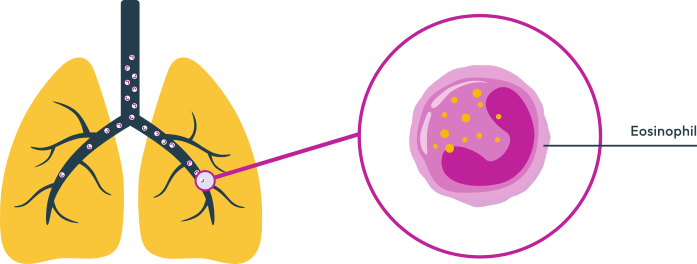
In some people with COPD, higher levels of eosinophils are linked to increased inflammation in the airways.
A high eosinophil count in the blood often doesn’t cause symptoms by itself. In some people with COPD, it can be a sign of a type of airway inflammation. This inflammation may make breathing feel harder and can increase the chance of having COPD flare‑ups.
If you have COPD and tests show that you have a high number of eosinophils, you may be prescribed Nucala as an add-on treatment to help reduce this type of inflammation.
Eosinophils (pronounced ee-oh-sin-oh-fills) are a type of white blood cell.
What is Nucala?
Nucala is a biologic medicine, meaning it is made from living cells and is designed to target a specific part of the immune system.
It works by targeting a specific protein called interleukin-5 (pronounced in-ter-loo-kin five), or IL-5 for short. IL-5 plays an important role in helping eosinophils grow and survive in the body.
By blocking IL-5, Nucala helps reduce the number of eosinophils in the blood. With fewer eosinophils, there may be less inflammation in the airways, which may help reduce COPD flare-ups.
Nucala must not be used to treat acute COPD flare-ups/exacerbations.
What to expect
Nucala is an injected medicine, given under the skin (taken once every four weeks), that works gradually by helping reduce the number of eosinophils in your blood. This may help reduce airway inflammation and lower the risk of flare-ups over time. It’s important to take Nucala exactly as prescribed.
How to self-inject
Are there any side effects?
Like with all medicines, Nucala can cause side effects, although not everybody gets them. These are usually mild to moderate but can occasionally be serious.
Allergic reactions
Some people may experience allergic or allergic-like reactions; these reactions may be common and can
affect up to 1 in 10 people.
Usually, they occur within minutes to hours after the injection, but symptoms can start
up to several days later.
These can include:
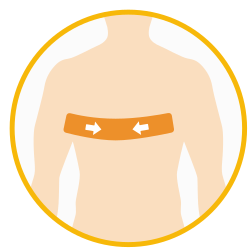
Chest tightness, cough, or difficulty breathing

Fainting, dizziness, or feeling lightheaded

Swollen eyelids, face, lips, tongue or mouth

Hives or rash

You should seek medical attention immediately if you think you may be having a reaction. If you may have had a similar reaction to any injection or medicine, tell your doctor, nurse, or pharmacist, before you are given Nucala.
Other side effects
Very common: may affect more than 1 in 10 people
- Headache
Common: may affect up to 1 in 10 people
- Sore throat
- Back pain
- Joint pain
- Stuffy nose
- Eczema (itchy red patches on the skin)
- Upper stomach / abdominal pain
- Chest infection (symptoms may include cough and fever)
- Urinary tract infection (painful or frequent urination, fever, lower back pain, or blood in the urine)
- Herpes zoster (shingles)
- Injection-site reaction (pain, redness, swelling, itching, or burning where the injection was given)
- Fever
Rare: may affect up to 1 in 1,000 people
- Severe allergic reactions (anaphylaxis)
Tell your doctor, nurse, or pharmacist immediately if you get any of the symptoms mentioned above
Be sure to report your side effects
If you notice any side effects, let your doctor, nurse, or pharmacist know. This includes anything not mentioned on this website.
You can also report any side effects through the Yellow Card Scheme, which helps to improve the safety of this medicine. You can do this at www.mhra.gov.uk/yellowcard or through the MHRA Yellow Card app in the Google Play or Apple App Store. For further information on side effects, please read the Patient Information Leaflet (PIL) that comes with your medicine.
Frequently asked questions (FAQs)
Nucala is a long-term, maintenance treatment. It works gradually over time by reducing the number of eosinophils in your blood, which may help reduce airway inflammation and lower the risk of flare‑ups. Because Nucala is used for long‑term control (not quick relief of sudden symptoms), you may not notice an immediate change after starting treatment; benefits often build over time with regular dosing every four weeks.
You or your caregiver can inject the missed dose as soon as you remember. If it is already time for your next dose, skip the missed dose and take your next dose as planned. If you are unsure what to do, ask your doctor, nurse, or pharmacist.
You may feel some pain or discomfort at the injection site. Letting the Nucala pre-filled pen reach room temperature for 30 minutes (no more than 8 hours) before injection may help with the pain.
Nucala should be stored in a fridge at 2-8°C. However, it can be stored at room temperature (up to 30°C) for no more than 7 days when kept in the original carton. This might be useful if you have to travel with your Nucala. However, please remember that if you take your medicine out of its carton, it should be used within 8 hours.
Your doctor, nurse, or pharmacist can help to address any questions or concerns you or your caregiver have about your injection.
Don’t use this dose of Nucala. Contact your doctor, nurse, or pharmacist to report the issue with the treatment.
Check whether the inspection window is filled with the yellow indicator. If you are unsure, keep the pen pressed down for another 15 seconds. If you lift the pen too early or still think you may not have received your full dose, contact your doctor, nurse, or pharmacist for advice.
If you think you have injected too much Nucala, contact your doctor, nurse, or pharmacist for advice.
Yes. Nucala is an add-on treatment, intended to be used in addition to your existing COPD medicines, not instead of them. Do not suddenly stop or change any of your medicines unless your doctor, nurse, or pharmacist tells you to.
Do not stop Nucala injections unless your doctor, nurse, or pharmacist advises you to. Interrupting or stopping the treatment with Nucala may cause your symptoms and flare-ups to return. If your symptoms worsen while receiving Nucala injections, contact your doctor, nurse, or pharmacist.


June 2026 | NP-GB-MPL-WCNT-260004
All images on this website are for illustrative purposes only. These are not real patients.